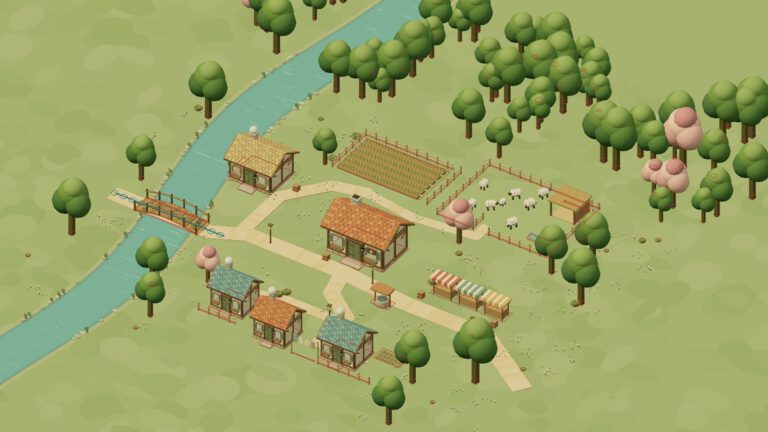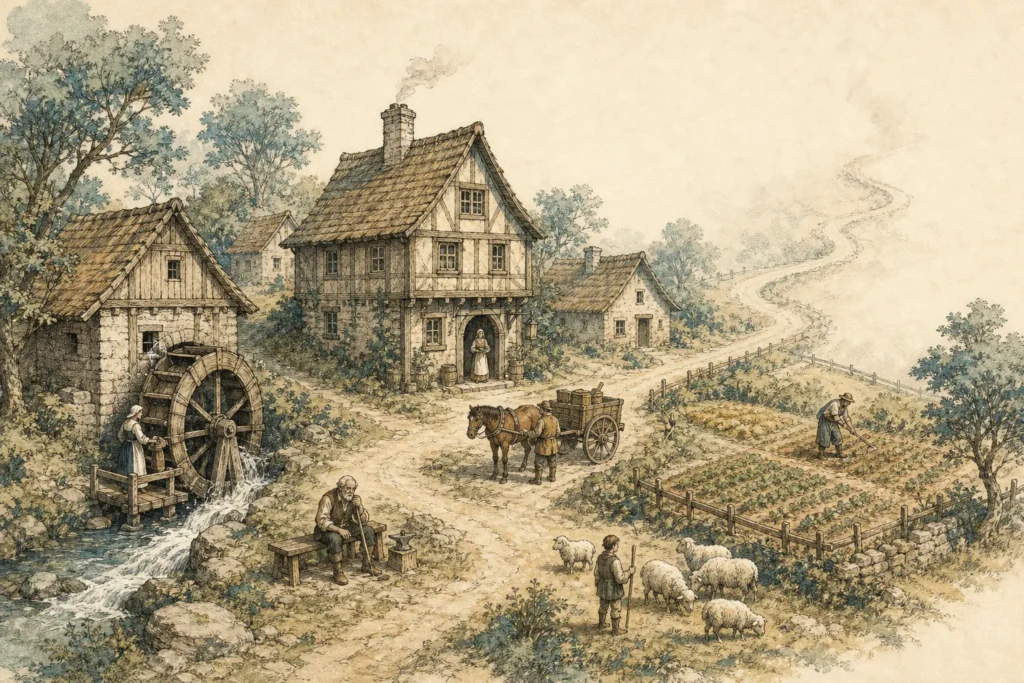
Jevs Village is my live AI village simulation, built with Jev, TypeSafe AI’s decision model. Six villagers work, rest, remember, and respond to one another in a world that continues between visits. I built it to explore a practical question: can a fast, low-cost decision model support a small community of simulated agents?
There is also a mystery. In the village’s lore, everyone was born and raised here. Nobody can reliably say what lies beyond its boundaries.
They have fields to tend, flour to grind, and neighbours who do not always agree. Life gives them plenty to do without answering that question. But some of them would very much like an answer.
You can visit Jevs Village in your browser. There is nothing to install and no API key to bring.
From thinking about Jev to building with it
In my earlier article about Jev as a fast nervous system for AI agents, I tried to work out where a decision model belongs alongside language models and ordinary code.
Jevs Village takes that question into a setting we can watch.
A village needs many small decisions. Keep working or take a rest? Attend to a need or interact with a neighbour? Which remembered experience matters in this situation?
Generating a long written answer for each choice is not necessarily useful. Often, the application needs a selection from actions it already understands. That is the use case I wanted to explore with Jev.
The live village currently reports Jev 1.13.0 as its decision model. TypeSafe’s model documentation lists that version as the current stable release and the target of jev-latest at the time of writing.
A village that cannot explain what is outside
The uncertainty about the outside world is part of the story’s premise, not a claim that these agents are conscious or trapped.
Mira has never passed the last stone on the road. Nia knows the nearby paths, but has never been beyond the flooded ford. Old Père has lived through more village years than anyone, yet cannot explain what lies beyond either.
Tomas makes the mystery stranger. He takes his cart out and returns with goods and prices, but cannot say what he passes along the way. At Sela’s inn, travellers come and go without agreeing on the names of the places they came from.
That leaves room for different reactions. Curiosity does not have to look the same in every character. One person may want to follow the road; another may want to understand an old object or read a forgotten mark.
For me, that is an interesting setting for AI personality: a shared unanswered question, but different reasons to care about it.
Meet the six villagers
These introductions describe their public character profiles and lore, rather than claiming that every trait appears in every decision.
Mira, the miller
Mira learned her trade from her father. She is exact, fair, and proud of keeping the mill running. Everyone trusts her scales, even if her directness can feel a little cold. She checks her measures twice and shows kindness by helping rather than making speeches. Beyond the day’s work, she would like to know where the mill’s stones came from.
Bram, the farmer
Bram has worked the north field since he was fourteen. He is stubborn, dependable, and a man of few words. Losing half a harvest to standing water left him wary of the weather, and he often argues with Mira about the price of grinding. He knows land and roofs better than small talk. The north road leads toward something he cannot explain.
Nia, the herder
Nia looks after the animals, knows the local plants and paths, and brings herbs to Sela. She is curious, restless, and quick to ask questions. Long speeches test her patience. She has never crossed the flooded ford, but unlike someone content to wonder from a distance, she means to go and see what is beyond it.
Tomas, the carter
Tomas hauls goods with his old mare, Bess, and a cart that gives him things to complain about. He is cheerful, cheeky, and difficult to pin down when the conversation turns to money or promises. His journeys bring goods back into the village without giving him a clear account of the world outside. He wants to know where the road really leads.
Sela, the innkeeper
Sela took over the inn from her aunt and kept it open through hard winters. She welcomes guests, looks after the sick, and usually hears the news before anyone else. Her warmth comes with curiosity and a good memory for unpaid tabs. The travellers passing through her inn leave her with another question: where do they truly come from?
Old Père, the elder and retired smith
Old Père spent forty years as the village smith. He made the ironwork on Mira’s mill wheel and remembers the bad year when the village went hungry. He warns, advises, and sometimes repeats himself because he wants those lessons remembered. He has no reliable explanation of the outside world either. He would like the village to read what the old marks say.
How Jev turns a situation into an action
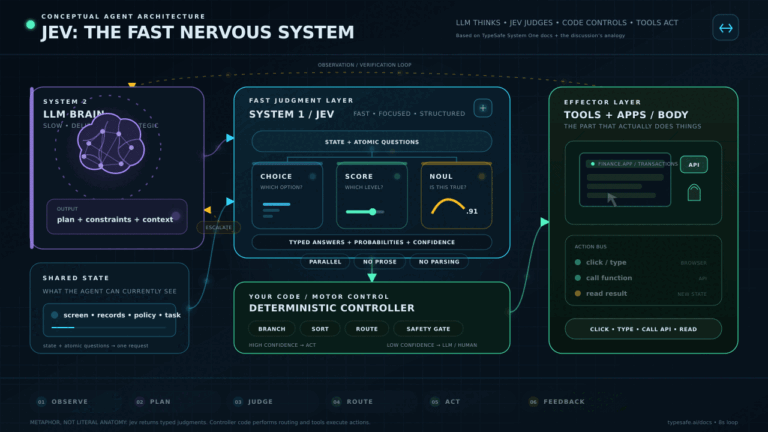
Jev is a decision model, not the narrator of the village. It receives context and typed questions, then returns structured answers rather than generated prose.
The village’s documented decision cycle separates the responsibilities:
- Code assembles a villager’s situation, including needs, location, and surrounding activity.
- The simulation supplies actions that are currently allowed.
- Relevant personal memories can accompany those options.
- Jev evaluates the choices.
- Code checks the selected action again and records its effects.
- A separate language model turns recorded events into readable narration.
Imagine Mira has milling work waiting but is getting tired. Continuing work and resting might compete for her attention, depending on what the world currently allows. This is an illustrative situation, not a report of a particular live event.
Jev helps choose. The simulation still decides what the choice can change. A decision to work cannot create missing grain, and a sentence in the chronicle cannot secretly add flour to the store.
That separation matters to me. I want the story to follow the consequences of actions, rather than let a convincing sentence become a fact just because it sounds right.
If you want the full mechanics, I wrote up how each villager’s decision is actually built: what Jev sees, why the state is written as perception, and how sampling turns probabilities into personality.
Why speed and cost matter for an AI village
A persistent simulation keeps asking for decisions. Even small costs can matter when those requests repeat across characters and days.
TypeSafe currently lists Jev 1.13 at $0.042 per million input tokens, with output tokens free. The company also reports large speed and cost advantages on its own System One workflow evaluations. Those are vendor-reported results, not measurements of Jevs Village.
The price makes Jev interesting for this experiment, but it is not the village’s total operating cost. Narration, hosting, and the number and size of requests also matter. A proper cost comparison would need measurements of the whole application.
The village’s main decision cycle runs every ten minutes. Animation runs separately: a villager walking across the scene does not trigger a fresh AI call for every frame. New decisions can also pause if a service is unavailable or the daily allowance is exhausted.
A fast model and a slowly unfolding village are compatible. The model makes a narrow judgment; the world gives that judgment time to have consequences.
Memory gives the villagers different pasts
The inhabitants share a world, but they do not all have the same record of it.
The village’s agent memory system keeps experiences for individual inhabitants. Witnessing something and hearing about it later are different sources of information. Relevant memories can inform later decisions.
During sleep, a review process can judge which experiences remain useful for personal recall. Calling this “dreaming” is a convenient story label. It is an engineered memory-retention process, not evidence of human-like dreams or feelings.
This connects with my interest in AI personality engineering. A character becomes more interesting when its history can matter to later behaviour. Whether that behaviour remains coherent is something to examine over time, not assume from a well-written character card.
What I want to watch next
Jevs Village is a small working demonstration, not proof that we can simulate a real society. A legal action can still be a poor choice. A relevant memory can be missed. A confident answer can still be wrong.
I am interested in whether the villagers remain recognizably different as their circumstances change, and whether their shared history gives us reasons to return.
If you visit, choose one inhabitant and follow their public activity alongside the chronicle. Come back after later updates and compare what changed. You do not need to understand the API to notice that someone keeps working, avoids a conversation, or becomes curious about the road.
Step into Jevs Village. I want to see what these small decisions add up to, and what happens to village life when the question of the outside becomes harder to ignore.