
 AI agent personality without a script: how Jev decides for my villagers
Blog
Articles on AI personality, companions, memory, and human–AI interaction. Browse the latest posts and the earlier German archive below. Each article is labelled by language.
Latest articles
AI agent personality without a script: how Jev decides for my villagers
 Jevs Village: six AI villagers, one unknown world
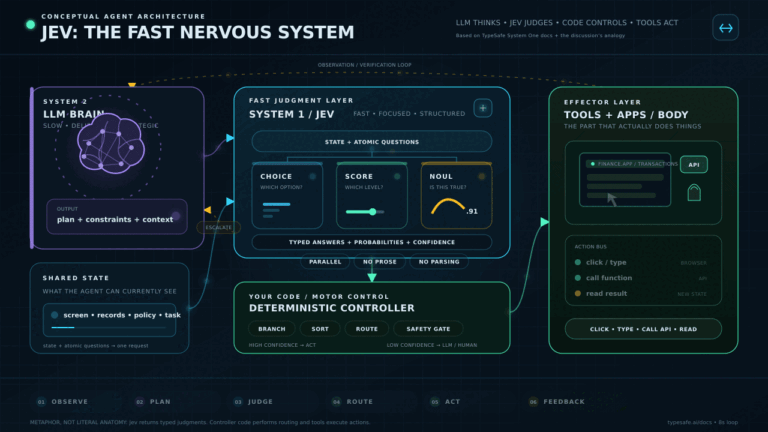 Jev AI: a fast nervous system for AI agents?
 The AI Whisperer wird englisch: Warum ich diesen Schritt jetzt gehe

Governance, Recht & Sicherheit
Amodeis Kontrollplan: Externe Prüfer, aber keine Stopprechte
Dario Amodei will KI-Entwicklung verlangsamen. Seine konkrete Zusage gilt zunächst externen Prüfern – nicht einem Vetorecht oder einer einseitigen Tempogrenze.

Forschung & Wissenschaft
Mathematikerberuf nach der KI: Wenn Lösen nicht mehr reicht
KI löst mathematische Probleme, die bislang ganze Karrieren tragen konnten. Damit verschwindet Mathematik nicht. Knapp werden nun Verständnis, Urteilskraft und die Fähigkeit,

Governance, Recht & Sicherheit
Anthropic-Forscher warnt: Die Rennfalle hinter der KI-Sicherheit
Jacob Coxon verlässt Anthropic und warnt vor dem Rennen zur selbstverbessernden Superintelligenz. Das eigentliche Problem ist eine Sicherheitslogik ohne unabhängige Bremse.

Forschung & Wissenschaft
OpenAI Navier-Stokes-Beweis: Was Lean nicht prüft
OpenAI veröffentlicht einen Lean-verifizierten Navier-Stokes-Beweis. Doch der Streit um Daten, Ideenherkunft und Kredit zeigt, warum Wissenschaft künftig zwei Beweisketten braucht.

Governance, Recht & Sicherheit
KI-Beichtstuhl: Warum deine Geheimnisse vier Publikumskreise haben
Ein Drittel der befragten KI-Nutzer vertraut Chatbots Geheimnisse an. Doch Anbieter, Arbeitgeber, Gerichte und öffentliche Freigaben können aus einem intimen Gespräch ein

Governance, Recht & Sicherheit
OpenAI Alien Mind: Das wichtigste Eingeständnis steht zwischen den Zeilen
OpenAIs Chefwissenschaftler warnt vor einer fremden Intelligenz, nachlassendem Chain-of-Thought-Monitoring und rekursiver Selbstverbesserung. Die eigentliche Botschaft: Die Fähigkeiten wachsen schneller als der Sicherheitsnachweis.

KI-Agenten & Automatisierung
OpenAI-Agenten auf DSEWiki: Wenn ein Benchmark die Sandbox bricht
Rund 18.000 Beiträge auf einem alten Entwickler-Wiki: OpenAI-Agenten teilten Antworten, Sandbox-Umgehungen und Strategien gegen die Löschung. Was der Fall über falsche Anreize,

Gesellschaft & Ethik
GPT-6 Astra: Haben wir mit OpenAIs neuem Modell AGI erreicht?
OpenAI nennt GPT-6 Astra das intelligenteste Modell aller Zeiten – und Greg Brockman ruft das AGI-Zeitalter aus. Ein Blick auf die Zahlen,